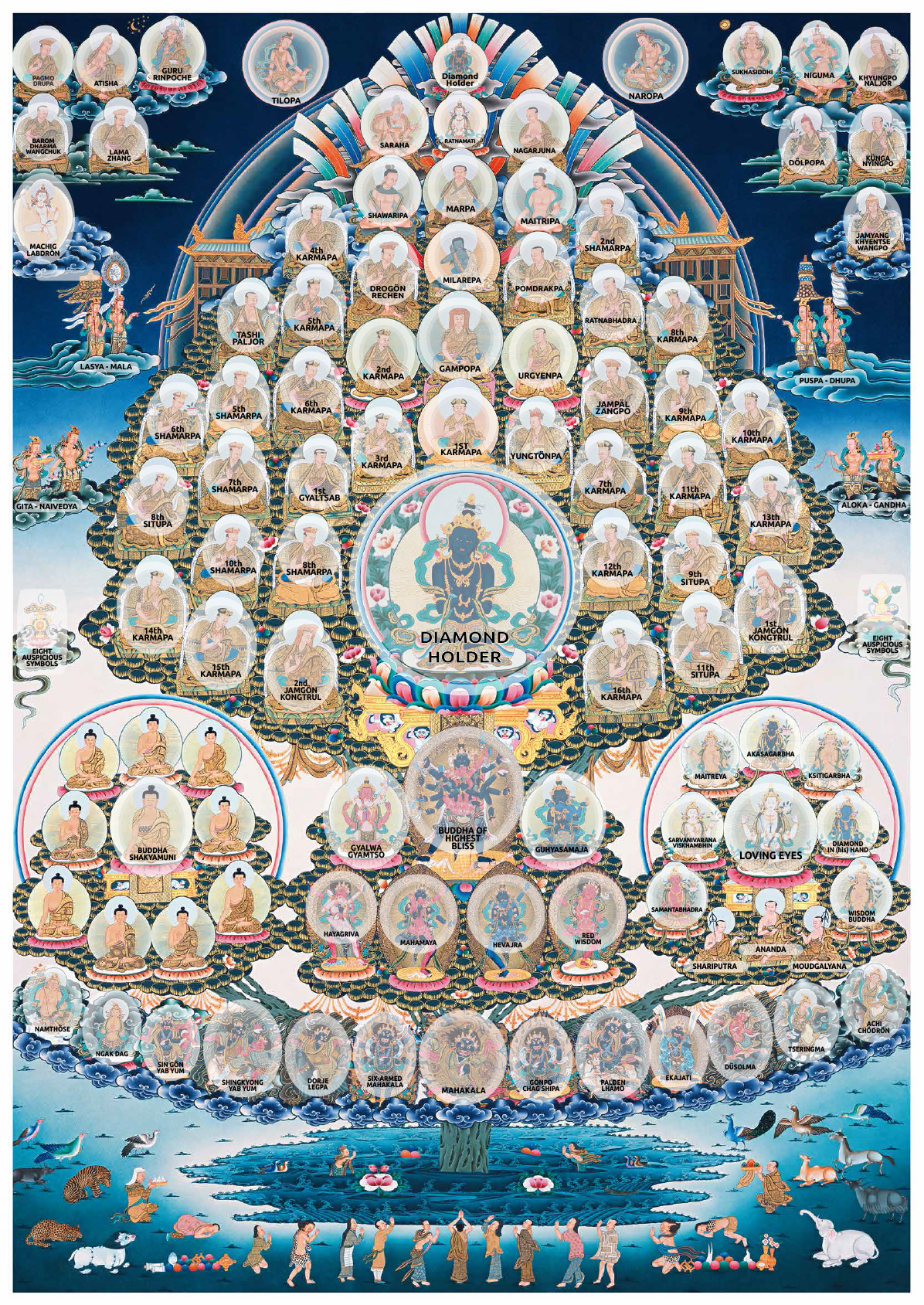

Tilopa (988–1069) was a great Indian meditation master and mahasiddha. He united the complete transmission of the Diamond Way in himself. He passed it on to his main student Naropa and thus became the forefather of the Kagyü lineage.

Naropa (1016-1100) was a tantric Buddhist master, student of Tilopa, teacher of Marpa,
and one of the 84 mahasiddhas.
He was known for his exceptional dabating skills and his comprehensive knowledge which caused hindrances for his realization for many years.
One of his main contributions to the DW methods is his collection of the yidam practice
Inner Heat, Illusiory Body, Clear Light, Dream Yoga, Bardo and Phowa – known as the “Six
Teachings of Naropa“.

Guru Rinpoche (Tib. Pema Jungne, Skt. Padmasambhava, lit. “the Lotus Born”) was a
teacher who brought Buddhism, in particular the Diamond Way transmissions, to Tibet
in the 8th century. He led an exciting life and performed innumerable miracles.
With his termas (hidden teachings) and his prophecies of the tertöns (those who would reveal
them), he is seen as the founder of the Nyingma lineage.
Among his many prophecies, he also gave the names of all the future Karmapas and explained the reason for the Karmapa crises of the 1980s and 1990s.
He is also highly esteemed by the Kagyüs and the Sakyas.

Atisha (982-1054) – Atisha Dipamkara Srijnana, born as a prince into a royal family, is one
of the main representative of the Kadampa school.
He studied texts of different Buddhist (and Hindu) schools and philosophies, music, logic and art. He was the discipline monk of Vikramashila; Atisha met Marpa once on his way to Tibet, when Marpa wanted to meet his main teacher Naropa.
Atisha‘s Kadampa (= oral instruction) teachings included the lamrim, the stepwise path, which entered the Kagyü teachings and methods through Gampopa who, as a child and young man, had mainly
practiced Kadampa methods.
Pamo Drupa Dorje Gyalpo was one of Gampopa’s three main disciples and founder of the Phagdru Kagyü school, one of the four major Kagyü branches.
Growing up in poverty, he became a monk through the support of his uncle, also a monk, who was employed outside a small monastery. After studying within the Kadampa tradition and spending 12 years of his life with a tantric master of the Sakya school learning Lamdre, he in the end became one of Gampopa’s main students and reached full realization through his teachings of Mahamudra.

Lama Zhang (1123-1193) studied the Dharma from a young age on (his mother was an ex-nun). He was a student of Ga Lotsawa, and met Gomtsul, Gampopa’s nephew, who was in this time an important leader of the Kagyüpas.
Lama Zhang had a close relationship to the 1st Karmapa Düsum Khyenpa which lasted until the end of his life – both passed away in the same year.
During the time he spent under Gomtsul’s guidance, Zhang was responsible for protecting Lhasa from further threats of violence and destruction. Shortly after he started to build his own monastery close to Lhasa and became the most powerful ruler of Tibet at this time.
Lama Zhang was an unusual lama: he often behaved like a warlord, commanding forces in battles, at the same time, he had comletely realized Mahamudra and taught countless students. To people who went to Karmapa to complain about Lama Zhang, Dhüsum Khyenpa answered, “Those who don’t understand Lama Zhang don’t understand the Dharma.”
It is said that Lama Zhang and the 1st Karmapa considered each other equals. The only one who could tame Lama Zhang was Karmapa.

Barom Dharma Wangchuk (1127-1194) was one of Gampopa’s main students and founder
of the Barom Kagyü school, one of the four major Kagyü branches.
He was very close to Gampopa and saved his live several times. When Gampopa passed
away, he made a 100,000 clay images (tsatsas), containing the ashes of his teacher’s body.

Machig Labdrön (= mother of Lab [a region in Central Tibet]) lived between 1055 and 1153. During these times, she became unusually old. Her main teacher Padampa Sangye quickly recognized her realization (both were consorts as Guru Rinpoche and Yeshe Tsogyal – here in their respective emanations).
Machig Labdrön married early in her life. After their children could take care of themselves, she left the family and retreated into the forests. That’s why only very little is known about her second half of her life.
She gave the Chöd practice (cutting through ego-clinging) to the world. It was not her invention but it can be seen as an essence oft he Prajnaparamita teachings. Often only seen as an extreme exotic Buddhist practice (e.g. offering one’s body during a white or red feast; practicing on burial grounds etc.), Chöd contained a highly social and healthwise responsibility, as Hannah Nydahl once explained: „Chöd practitioners were a kind of hygiene-police – when epidemics occurred such as leprosy, pox or plague, these practitioners went in and hauled the sick and dead ones out of their houses and villages without ever being infected.“
Sukhasiddhi was a married woman with three daughters and three sons. She lived an average life for most of her life and was not aware that she was a yogini.
The monsoon once failed to come, many people almost starved. So she was expelled of her home and had to flee to Uddhiyana. Before she left out of compassion, she shared a big bowl of rice with a beggar (who was Virupa – but she didn’t know it at that time). Because of her diligence and compassionate activity she met Virupa again who became her root lama.
She reached enlightenment in her mid-sixties, donating the dharma two gifts: first are the Six Teachings of Sukhasiddhi (similar to the ones of Naropa), and second, together with Niguma, Maitripa, Khyungpo Naljor and others she founded the Shangpa Kagyü School of Tibetan Buddhism.
Niguma – The Yogini adorned with Bone Ornaments is considered one of the most important and influential yoginis and Vajrayana teachers of the 10th or 11th century in India.
She was a dakini, and one of the two female founders of the Shangpa Kagyü school of Vajrayana Buddhism, along with dakini Sukhasiddhi. Her birth name was Shrijnana (or Palgyi Yeshe in Tibetan).
Like many of the mahasiddhas and tantric practitioners of the time, Niguma was known by several names both during her lifetime and afterwards. She was called Yogini Vimalashri, or Vajradhara Niguma, or Jnana (wisdom) Dakini Adorned with Bone (ornaments), or The Sister referring to her purported relationship to the great Buddhist teacher and adept Naropa. She was also sometimes called Nigupta, which is explained by the historical Buddhist scholar Taranatha as follows, “The name Nigu accords with the Indian language, which is Nigupta, and is said to mean ‘truly secret’ or ‘truly hidden.’ In fact, it is the code-language of the dakinis of timeless awareness.”
She is the consort of Four-Armed Mahakala. She rides over a blood lake on a donkey marked with a white blaze.

Khedrub Khyungpo Naljor (1050/990-1127) was the founder of the Shangpa Kagyü school; he is said
to have been a disciple of Niguma (consort of Naropa) and Sukhasiddhi (a female disciple of Virupa), but he also learned from other great masters of this time, like Maitripa, Rahula, etc..
He was born in south Tibet in a wealthy family – the clan of Garuda. Well educated in
reading, writing, arithmetic and astrology, he first started to study Bön. Afterwards he
practiced Dzogchen and finally Mahamudra. On his journeys to India and Nepal he learned
from around 150 different yogis and from the wisdom dakinis Niguma and Sukhasiddhi
he received direct transmissions from Vajradhara.
Jamgön Kongtrul regarded Khyungpo Naljor as the greatest master ever to have graced Tibet after Guru Rinpoche and his 25 disciples.

Dölpopa Sherab Gyaltsen (1243 – 1313) was a representative of the so-called Buddhist Jonang tradition. They emphasized the meditation on Kalachakra and the Shentong view of emptiness.
Through the the way the Gelug administration during the time of the 5th Dalai Lama they suffered a severe decrease of practitioners. Their main region of activity became Amdo.
Through Dölpopas works a deep influence was exerted on many famous realized Buddhists, such as the 3rd and the 8th Karmapa, the 8th Situpa, Jamgön Kongtrul Lodrö Thaye and Kalu Rinpoche.

Sachen Künga Nyingpo (1092 – 1158) was one of the “five honorable masters“ who brought the Sakya tradition to its fruition. He was the son of the founder the Sakyapas, Khön Könchog Gyalpo, the first throne holder Sakya Thridzin. Sachen himself became the third.
He systemized the Sakya teachings, furthermore he became famous because of his works on the Hevajra Tantra and the systematical teachings of Lamdre (path and fruition). Therefore, he is seen as an emanation both of Loving Eyes and Wisdom Buddha.

Jamyang Khyentse Wangpo (1820-1892) was born in the region of Derge. He had
already contact to both Sakyapa and Nyingmapa in his youth and was recognized as the
reincarnation of the famous tertön Jigme Lingpa (1730-1789).
He himself became an important 19th century tertön and next to Jamgön Kongtrul and Chögyur Lingpa one of the three main figures within the Rimé movement. Their close bonds were based on
friendship and they exchanged many teachings and transmissions of a huge amount of
things they had learned from many teacers from all lineages of Tibetan Buddhism.

Diamond Holder (Skt. Vajradhara, Tib. Dorje Chang) is a primordial Buddha in Joy State (Sambhogakaya) and most important for the Kagyü lineage sitting central in the refuge tree.
He is the origin of our transmission being the embodiment of the teacher himself.

In the past many tried to explain the unexplainable, to describe the indescribable or to comprehend the incomprehensible with Ratnamati.
Every statement around him was barely anything about the course of his life, it was merely an attempt to give us an idea who he really was.

Undoubtedly Saraha was one of the greatest minds India has known. He had a profound influence upon Indian Buddhism as a result of his level of realization and his teachings on Mahamudra.

Nagarjuna is famous for his impact on all levels of Buddhist teachings, both for the Great Way and the Diamond Way. Besides his importance for the Mahamudra transmission lineage, he had great influence according to the building up and completion phase of tantric meditation, e.g., the meditation on Kurukulla, and the meditation on Guhyasamaja.

There are just a few biographical fragments that exist of Shawaripa’s life. They describe him sometimes as a hunter and sometimes as a dancer. His main contribution to our lineage is the practice of Vajrayogini.

Maitripa, also known by the names Maitrigupta, Maitripada or Advayavajra, became highly influential both in in the Great Way and in the Diamond Way.
It is through him that Maitreya's and Asanga's crucial work on buddha nature, the Uttara Tantra Shastra, became widespread in Tibet. He also transmitted the tantric aspect of buddha nature, embodied in the Mahamudra teachings, which treat the topic of mind in great detail and provide a wide range of progressive, highly refined meditations.

Marpa is seen as the father of the Kagyü lineage. He translated and installed the Dharma, which he received during his three journeys to India from many famous scholars and yogis, in his home country Tibet. These dharma teachings are now known as Tibetan Buddhism.
Traveling for a total of 21 years, he underwent hard times while learning, meditating and receiving all the transmissions. In Tibet, he lived as a lay practitioner and Buddhist teacher, as a landlord with family.
Marpa is said to have been a man of exceptional power and wisdom, although his behavior often shocked those around him.

Milarepa is considered to be the greatest yogi of all time. He is an example that enlightenment is possible within one lifetime and moreover can be realized through sheer devotion, without studying extensively.
Once, he is said to have stated, “I went to meditate in the mountains to overcome the eight worldly dharmas.”
Those are, hope for gain and fear of loss, hope for pleasure and fear of pain, hope for a good reputation (fame) and fear of a bad reputation (disgrace) as well as hope for praise and fear of blame.

Gampopa unified the stepwise path of the Kadampa tradition, with which he had grown up with the meditations focused on Mahamudra, which he had learned from Milarepa, from whom he received the full Kagyü transmission.
Also, the Ngöndro idea had its origin in Gampopa or rather in Milarepa, who showed his scarred behind to him in the moment of goodbye. Gampopa understood the information: “Meditate!” and increasingly instructed his students to practice on one of the meditations we now call Ngöndro. Both Gampopa’s students and he himself had long periods of time to practice in solitude.
In addition, as a monk, Gampopa rounded off the picture of the three types of practitioners at the beginning of the Karma Kagyü lineage: he was a monk, his teacher Milarepa a yogi and Marpa a layman.

Düsum Khyenpa, known as the 1st Karmapa, studied and practiced the Dharma of various Buddhist traditions from an early age until, at the age of 30, he met Gampopa, his root lama. From him he received the complete Kagyü transmission.
This was the beginning of the Karma Kagyü lineage.
The 1st Karmapa is said to have practiced tirelessly, e.g., he spent nine months in Shinay meditation and devoted three years of his life to the study and practice of Mahamudra and the aspect of Vajrayogini. Additionally, he built several monasteries, from which Tsurphu became the main seat (until 1959). He also built the well-known Kama Gön Monastery.

Like the Situ Rinpoches who came later, Drogön Rechen is regarded as an emanation of Maitreya, a close student of Buddha Shakyamuni, who is predicted to be a future Buddha.
Even in his early childhood, Drogön Rechen showed his devotion to spiritual practice. Because of this attitude, he received many teachings and initiations – both from the Kagyü and the Nyingma lineage.
He did not meet his most important teacher, Düsum Khyenpa, the 1st Karmapa, until he was about 37 years old. Karmapa put him to the test before accepting him as a disciple and later made him his successor by giving him the secret Mahamudra transmissions.

Pomdrakpa Sönam Dorje is the first in the lineage to find the letter with the instructions for Karmapa’s next rebirth and to confirm that the child was Karmapa. Pomdrakpa also established the tradition of giving all teachings and transmissions to the child, even if he (the child) had already attained enlightenment in his previous life, so as not to interrupt the transmission stream of the lineage.
Pomdrakpa, who, like his teacher before him, began his meditation practice as a young child, had many visions. When he was a teenager, he recognized his teacher Drogön Rechen through a vision of the Red Dakini. It is also said that Pomdrakpa had a special connection to wisdom buddha aspects, which often appeared to him during his meditation practice. He later became the next lineage holder when he saw his teacher, Drogön Rechen, as Buddha Shakyamuni surrounded by countless buddhas, which was an auspicious sign that he would be able to hold the lineage.

From a very young age, the 2nd Karmapa was very skilled in his dharma practice. When he met Pomdrakpa, who became his root lama, he (Pomdrakpa) had a vision, that this talented child was an incarnation of Düsum Khyenpa, the 1st Karmapa.
When he was around 22 years old, Karma Pakshi’s main practice became Tummo.
Karma Pakshi traveled extensively, built, and restored monasteries, and was famous for introducing the public chanting of the Om Mani Peme Hung mantra throughout Tibet. He was also able to master the elements. He once ordered a Buddha statue made out of brass to be built and when the head of the Buddha statue was askew on the neck, he put it straight just through meditation.
He showed the Mongol Emperor, Kublai Khan his power by performing miracles, and became, in a limited sense, his teacher, (though Kublai Khan initially wanted to kill him because Karma Pakshi didn’t follow the Khan’s wishes).
Before Karma Pakshi died, he announced that his future rebirth would occur in two incarnations: as Karmapa and Shamarpa.

Urgyenpa already knew how to meditate while he was still a child. It is said that he was an emanation of Rechungpa and Khorlo Demchog. Despite this natural gift, he decided to study philosophy before beginning a serious meditation practice.
He was very headstrong, which meant that he only succeeded in making the transition from being a scholar to becoming a tantric practitioner late in life. He is known for his incredibly long journeys on foot, which he undertook to receive all the teachings he was able to.
It is said that Urgyenpa was obsessed with finding Shambala because he thought that only there could he realize the ultimate meaning of Kalachakra.
Only very late - at the age of 53 - did he meet the 2nd Karmapa, who gave him the Kagyü lineage transmissions and thus made him the next lineage holder.

Although the 3rd Karmapa showed all the qualities of enlightenment, his wisdom and knowledge stood out. He was likely the first to have a complete overview of the most important transmissions and the historical events of the time from Buddha Shakyamuni onwards.
He also initiated a tradition of the Karma Kagyü lineage, traveling with the lama. Practitioners traveled with Karmapa in a foldable tent village called a garchen. In addition to his other tasks, he cared for his fellow travelers, both with regard to meditations and transmissions. The tradition of traveling with the lama continues to this day.

Yungtönpa was one of the most respected Buddhist scholars of his time. He studied and practiced with incomparable endurance under many masters of the Nyingma and Kagyü tradition.
As a young man he started a family at the request of his mother, which he left after the birth of his first child to become a Buddhist monk with the name Dorje Pal. Afterwards he met the 3rd Karmapa, Rangjung Dorje, whose successor he became.
Yungtönpa was known for his material generosity, but above all for being a master of the distinction between sutra and tantra and for bringing benefit to many through his teachings.

Like many of the past and future Karmapas, Rölpe Dorje distinguished himself through special enlightened qualities and their expressions.
In his previous incarnation, Karmapa had left clear instructions with his secretary, Rinchen Pal, to look for specific signs in order to find the reincarnate child quickly. At the age of six he took refuge vows and the lay precepts from a lay practitioner ( who also taught the young Karmapa all fields of Tantrayana).

Khachö Wangpo was recognized by the 4th Karmapa as the reincarnation of the 1st Shamarpa Khaydrup Dragpa Senge, when they met. He became his disciple and later the Karmapa granted to him the ceremonial Ruby Red Crown, and thus officially giving him full responsibility for the Karma Kagyü lineage – in equal shares with himself.
As Buddha Shakyamuni had prophesied in the Badrakalpika Sutra, the Sutra of the Happy Era, Shamarpa’s compassion was immeasurable. He was one of the first lineage teachers to write down and publish the most important of his teachings so that they would endure and be accessible to a wide audience of Dharma practitioners. But he also cared about the welfare of other living beings, e.g., founding anmimal welfare organizations.

Dezhin Shegpa, who identified himself as the 5th Karmapa at the moment of his birth, came as a child into the care of his former disciple, Kachö Wangpo, the 2nd Shamarpa.
It was characteristic of the 5th Karmapa that he demonstrated many miracles on his journeys through Tibet, Mongolia and China. He also taught tirelessly, a result of which, was the Chinese emperor, Tai Ming Chen, became his devoted disciple.
Thanks to his (the emperor’s) high level of realization, he was able to see the power field above his teacher's head and had a replica made in the shape of the Black Crown out of gratitude. Dezhin Shegpa and the Karmapas after him showed this during the infrequent Black Crown ceremonies, making the blessing from this power field accessible to many. Since then, the Black Crown has been an integral feature of the Karmapas.

The exact lifetime of Ratnabhadra is just as little known as the time and circumstances under which he met the 5th Karmapa and became his disciple, and later became the Mahamudra lineage holder.
However, sources confirm, that he was one of the greatest scholars of his time. Above all, he mastered the teachings of the sutras and tantras and therefore was called “Rigpe Raltri” (sword of philosophy and logic). It is also said that it quickly became clear that he was an emanation of Loving Eyes; many also recognized in him the incarnation of Rechungpa.

The 6th Karmapa, Tongwa Dönden, began his education at the monastery of Karma Gön when he still was a baby. He met Ratnabhadra, the holder of the Kagyü transmissions, at the age of three. By this time, the child had already begun to teach.
Tongwa Dönden’s life’s work shaped the Karma Kagyü lineage by developing a consistent lithurgical system with which he supplemented the meditative tradition of the Kagyü school. He wrote many Kamtshang sadhana rituals and also created a new style of recitation and chanting.
In contrast to his activity of previous incarnations, but due to the increasing difficult political conditions, the 6th Karmapa refused invitations from the Chinese and Mongolian rulers in this life and only traveled across Tibet, interrupted by longer retreats and the restorations of monasteries.

When Jampäl Zangpo met the 6th Karmapa and became his disciple, he had already undergone comprehensive study and Dharma practice with great teachers of his time, such as Rongtönpa. His devotion to the Karmapa was so immense that he wished to deepen and consolidate his teacher’s instructions through intensive meditation practice.
After a subsequent 18-year retreat, Jampäl Zangpo composed the invocations of the Kagyü lineage, which is still chanted in the beginning of the Phowa practice, (as many Diamond Way Buddhists know from the Phowa meditation with Lama Ole) and which carries a special blessing, the Dorje Chang Thungma.
Paljor Döndrub , the 1st Gyaltsab Rinpoche, received a comprehensive Buddhist education as a child under the guidance of great meditation masters, particularly the 6th Karmapa, his root teacher, and then took over the leadership of Tsurphu Monastery at the age of 14 at his (Karmapa’s) request.
He received the title ‘Goshir’ from the Chinese emperor, meaning ‘state teacher’.
The Gyaltsab Rinpoches are part of the activity of the Bodhisattva Vajrapani. In the past, Rinpoche had incarnated as Ananda, the disciple of Buddha Shakyamuni who had perfect memory and was responsible for reciting all of the teachings of Buddha to the practitioners. Often their names were additionally termed with the Chinese title, Goshir or Gushri (lit.: state teacher).

Chödrag Gyamtso’s root teacher was Jampäl Zangpo, who passed on many of the important Kagyü lineage transmission to him when he was a child and lived in the monastery of Karma Gön.
Gyaltsab Paljor Döndrub, however, was the one who recognized and enthroned him as the new Karmapa incarnation before. Chödrag Gyamtso later received the full lineage transmission for the second time from him, probably after returning from the seven-year retreat that he began at the age of 17. He later went on to spend a large part of his life in full or semi-retreats.
The 7th Karmapa was well known far beyond the country’s borders for his scholarship. He always traveled throughout Tibet with a huge entourage of practitioners and set up camps with thousands of tents. He also taught, gave empowerments and wrote many texts, especially on the theory of perception. He said of himself that he was Dharmakirti in his previous life and was able to prove this (see stories).

Chökyi Döndrub spent the early years of his childhood in Nepal where he was born. This happened in honor of the king, who asked the special child to stay. Only when he was seven years old, he did follow the request of the 11th Karmapa to return to the seat of his predecessor, Tsurphu in Tibet. Here he received the Karma Kagyü transmissions from him before Karmapa died at a young age.
The 8th Shamarpa traveled tirelessly through Tibet and neighboring countries with his disciples to teach the Dharma. The 12th Karmapa and the Situ and Gyaltsab Rinpoches accompanied him. When both he and the 12th Karmapa, due to the black magic of their adversaries, died immediately one after the other of smallpox, the transmission lineage was in danger of being interrupted for the first time. However, the 8th Situpa Chökyi Jungnay became the next lineage holder.

When the 12th Karmapa was born, the 8th Shamarpa, then the current lineage holder, was only eight years old. The 8th Situpa, who was to become his successor due to the special circumstances surrounding the early death of the Karmapa and Shamarpa, was three years and the 7th Gyaltsab Rinpoche was four. Together with them, Karmapa Changchub Dorje later traveled to many countries, including Bhutan, Nepal, Sikkim, India, and China, giving transmissions and teachings to the people, they met.
He worked hard for peace in the world by performing ceremonies in Amdo and at Lake Kokon. He also managed, together with Kalzang Gyamtso, the 7th Dalai Lama, to persuade the Mongolian army to withdraw from Tibet and, by connecting with Loving Eyes, to stop an influenza epidemic.
His special connection to the Kalachakra Tantra manifested itself in an extraordinary way through dreams in which he visited the realm of Shambala and received the complete transmission from King Rigden himself.

With the nickname “Karsey”, which means “son of the Karmapa”, the 2nd Jamgön Kongtrul was born in Tsurphu Monastery and enjoyed an extensive education which, in addition to the 10 sciences, included treasures of various traditions of Tibetan Buddhism and above all the complete Karma Kagyü transmission from his father and root lama, the 15th Karmapa.
Palden Khyentse Öser rebuilt the Tsandra Rinchen Drak retreat above Palpung Monastery and generously passed on transmissions and teachings to his disciples on every possible occasion.

Rangjung Rigpe Dorje, the 16th Karmapa, was one of the most powerful Karmapas in the lineage. Already when he was a child, he naturally performed miracles until his teachers, (of whom the 11th Situpa and the 2nd Jamgön Kongtrul were, as he said himself, his root lamas), asked him to stop.
The 16th Karmapa was ordained at Palpung Monastery and began to study and practice under the guidance of Situ Rinpoche. His teachers included the greatest Karma Kagyü masters of his time.
At the age of 20, the Karmapa prepared himself and his disciples for the coming events of their escape from Tibet, well before the invasion by the Chinese. The nature of his preparations demonstrated once again that powerful quality, which changed everyone he met for the better, beyond all human understanding. He protected the teachings from the occupiers and safeguarded his activity by rebuilding Rumtek Monastery.
The Karmapa went on to entrust his closest disciples, of whom Hannah and Ole Nydahl were to become the most important, to bring Diamond Way to the West; in this way, a prophecy of Guru Rinpoche was fulfilled. Karmapa was the first of the lineage to circumnavigate the world and therefore was able to bring his blessings directly to the countries where the practicing Diamond Way world found their new homes. Lama Ole and his wife Hannah experienced themselves as the 16th Karmapa’s activities and continued to manifest the Diamond Way throughout free countries around the world.

The young Denma Drubchen was attracted to the 7th Karmapa, who gave him the name, “Tashi Paljor” when they met for the first time, when the boy was still very young. He decided to become a monk at the age of five and thus began the first phase of a life as an unconventional practitioner and yogi, following the example of the mahasiddhas, particularly Milarepa.
Tashi Paljor, who was also called Sangye Nyenpa, is said – according to Dilgo Khyentse Rinpoche – to have the emanation basis of the future Buddha Maitreya. It is also said that he is the reincarnation of the Indian master Jnanagarbha, one of Marpa’s teachers.

Mikyö Dorje revealed himself directly at his birth. Nevertheless, there was another child whose family claimed that he was the reincarnation of the 7th Karmapa. Although this family had a lot of influence, it quickly became clear to everyone who the real Karmapa must be.
The 8th Karmapa was one of the most brilliant philosophers of Tibetan Buddhism and in addition, unmatched in his devotion to his root teacher, Sangye Nyenpa Tashi Paljor.
He developed a guru yoga meditation practice in his lama's honor. We also owe the mantra “Karmapa Chenno” and the Mahakala Puja (which we use in the Diamond Way to invoke our protectors) to the 8th Karmapa.

The 5th Shamarpa chose for his rebirth one of the wildest areas within Tibet, Kyen Zhölmo Ché in the upper part of Kongpo. There was very little education in the region, but it had a stupa with precious relics (the teeth of Gampopa). When he met his root teacher, the 8th Karmapa, at the age of two he was immediately enraptured and stayed with him.
With his radiant and devoted character, he continued his teacher’s activity, held the Karma Kagyü lineage between the 8th and 9th reincarnations of the Karmapa and was also instrumental in the identification of his later disciple, the 9th Karmapa.
In addition to a number of notable treatises, he composed “A Song of Calling the Guru from Afar.” (see Quotes & Stories)

Wangchuk Dorje was quickly found by the disciples of his previous incarnation and was officially enthroned as Karmapa at the age of six by Könchok Yenlag, the 5th Shamarpa, who had held the lineage, and who from then on became his root lama (once again in this life).
The 9th Karmapa stood out due to his incomparable linguistic abilities, with which he was able to pass on the individual steps towards and realization of Mahamudra, what became his main focus in teaching his disciples and also generations thereafter in the form of three works.
His best-known book today is “Mahamudra – Ocean of Definitive Meaning”.
By enabling thousands to access the state of the Great Seal, he was honored by the people. He was also regarded as the ruler of Tibet because of his worldly prowess.

The 7th Shamarpa chose the circumstances of his rebirth exactly where his former disciple and future root lama, the 10th Karmapa, had expressly wished – in an eastern province close to China into a family of nomads. This was extremely important, as the Karmapa was in exile and was therefore able to seek out his disciple on foot, albeit still under difficult external circumstances, and take him with him.
Yeshe Nyingpo went from being a wild, courageous shepherd boy to a great example of a meditation master through his persistent devotion and meditation practice.

For his 11th rebirth as Yeshe Dorje, Karmapa chose, as in his first, seventh, and ninth incarnations, the wild Eastern Tibetan region known as Golog. The miraculous child was quickly found by his previous disciple, the 7th Shamarpa, who brought him to Tsurphu to give him the full Kagyü lineage transmissions.
Although the 11th Karmapa had the shortest lifespan of all the Karmapas (he lived only 26 years), in addition to the Kagyü teachings, he also received terma teachings in the Nyingma tradition of Guru Rinpoche, who had prophesied this centuries earlier.
From his childhood on, Yeshe Dorje oversaw the restoration of the Tsurphu Monastery, which had been badly damaged several times by the Mongols, and at the same time taught his disciples in his unique way in order to open their minds.

Mipham Chödrub Gyamtso, the 10th Shamarpa, was born into the family of the Panchen Lama, who is the most important spiritual teacher of the Gelugpa lineage next to the Dalai Lama and was recognized by the great Kagyü masters, the 8th Situpa and 13th Karmapa (who became his root lama).
However, his relationship to the Panchen Lama did not bring peace with the rival Gelugpa sect. On the contrary, he was eventually banished from Tibet and his influence was severely damaged from slander. In exile in Nepal, he was used as a negotiator between the Nepalese and Tibetans because Nepal’s king wanted to use Shamarpa’s high standing among the Tibetan people in his favor. When this did not work out and war broke out, Shamarpa was made a scapegoat by both sides.
None of this changed the important role of the 10th Shamarpa for the Karma Kagyü lineage. He received the lineage transmission, traveled extensively, taught tirelessly and was known for his unwavering patience and generosity even in the most difficult times.

Before his passing away, the 8th Situpa Chökyi Jungnay indicated that Pawo Rinpoche would recognize his incarnation. Pema Nyinche Wangpo, the 9th Situpa, began his Buddhist education as a child. His teachers included not only the 7th Pawo Rinpoche, who, as predicted, recognized him, but also the 13th Karmapa, the 10th Shamarpa, Mipham Chödrub Gyamtso and other realized masters.
Situpa was known for his generosity – for precious offerings but also for more than 200 treatises that he wrote. However, he spent most of his life in retreat.
His liberal free-minded character was instrumental in starting the Rimé movement, which was later continued by his disciples.

At his birth, Khakyab Dorje declared that he was the Karmapa. He was recognized and enthroned by the 9th Kyabgön Drukchen, the head of the Drugpa lineage, Mingyur Wanggi Gyalpo along with Jamgön Kongtrul, Jamyang Khyentse Wangpo, Terchen Chokgyur Lingpa, and Pawo Tsuklak Nyinchey, at the age of six.
He studied in Palpung, where he met his root lama, Jamgön Kongtrul Lodrö Thaye. The latter instructed him in the teachings of the Karma Kagyü lineage and the Five Treasures, familiarizing the young Karmapa with the view of the Rimé movement from the very beginning. The 15th Karmapa also sought out Jamyang Khyentse Rinpoche and traveled throughout Tibet to collect teachings and transmissions wherever he could to protect them from disappearing.
Through his connections with consorts, he was able to reveal important hidden treasure teachings, protect the lineage by becoming root lama to his own sons, the 12th Shamarpa and the 2nd Jamgön Kongtrul, as well as resolve an inner energy imbalance. Among the transmissions that go directly back to him is the Clear Light Meditation, which Lama Ole has passed on to many of his students.

Not much is known about Pema Wangchok Gyalpo, but the 15th Karmapa is said to have drawn a map describing the place of rebirth of his future disciple and lineage holder successor.
The 11th Situpa – according to his role – received all lineage transmissions from the Karmapa and Jamgön Kongtrul in Palpung. Later, he took care of the expansion of the printing press in Derge as well as his more than 108 small monasteries in Tibet. He also designed robes for the lama dances.
He was known and feared for his strict discipline, which he also demanded of his disciples.

Mipham Chökyi Wangchuk had an incomparable intellect. Through his close connection to his root lama, and the 9th Karmapa‘s sensitivity for the special child, he was able to train this from an early age coupled with an amazing memory, which was also evident in his realization.
It was said that he was Wisdom Buddha himself. He skillfully used his immense knowledge for the benefit of beings, emerged victorious from every debate and thus won many admirers, including later his disciple, the 10th Karmapa, who revered him as a Buddha and became not only his disciple but also his devoted servant.

Chöying Dorje was Karmapa at the time of the great upheaval in Tibet, which was characterized by intrigue, betrayal and war and was accompanied by violence and striving for power. Despite all this, the 10th Karmapa maintained the connection to his teacher, the 6th Shamarpa, and his reincarnation, (the 7th Shamarpa) and was therefore spared from the turmoil and became a great example of inner freedom through his devotion to his root teacher.
Very early in his life, the 10th Karmapa and his family were serfs; as an adult he was banished from Tibet, took a wife and had a son.
He was incomparably equanimous and one-pointed. He was also an exceptional artist. Wherever Karmapa traveled, he produced countless thangkas and statues, as well as adding a great number of pagodas, temples etc. Being a master of painting, metal casting and carving, he showed one of his highest qualities in the unusual way of visual expression.

During his childhood the 8th Situpa, Chökyi Jungnay, met both the 11th Karmapa, and six years later his reincarnation, the 12th Karmapa, who became his root lama and from whom he got the complete lineage transmission. At the same time the young Situpa was trained in philosophy and Tibetan medicine.
Chökyi Jungnay became an exceptional scholar and artist who worked for the benefit of all by taking every opportunity to make his knowledge available to as many people as possible in the form of works that remain important until today. He established the famous Derge printing press, close to where he founded Palpung Monastery, which became the main seat of the Situpas. Chökyi Jungnay was always close to the people, traveled a great deal and spoke several languages.

During the period when Düdül Dorje, the 13th Karmapa, was born, sectarian politics in Tibet escalated, leading the 7th Dalai Lama, Kalzang Gyatso, together with Polhane Sonam Tobgye, to pass a law that all government officials had to be Gelugpas. As a result, for the first time in Karma Kagyü history, the official approval of the Dalai Lama was required to recognize the new Karmapa incarnation.
By Düdül Dorje's overwhelming compassion, not only for his human disciples, but also for the animals and even his adversaries, whom he was able to pacify in later years solely through his special spiritual abilities, thus making a rapprochement between the Gelugpas and Kagyüpas possible.

Thegchok Dorje, the 14th Karmapa, enjoyed a multifaceted and extensive education. After several years in Karma Guen under the guidance of the 9th Situpa, he studied the complete Karma Kagyü and Nyingma transmission at Ogmin Ling Monastery and deepened his skills in Tsurphu, where, in addition to Situpa, who was his root lama, Drugchen Künzig Chökyi Nangwa, head of the Drukpa Kaygüs, played an important role as one of his main teacher.
His interest in learning worldly knowledge and skills, such as art and poetry, medicine and science, dialectics and rhetoric, reflected his openness to expanding his trove of Buddhist transmissions even at an advanced age. He received rare hidden teachings (termas) from his disciple Jamgön Lodrö Thaye, a treasure that had arisen from the mutual appreciation of the transmission lineages through the influence of the Rimé movement.
The 14th Karmapa was a strict ascetic and paid great attention to the observance of his disciples’ monastic vows.

Prophecies dating back up to Buddha Shakyamuni predicted the birth and deeds of the 1st Jamgön Kongtrul Lodrö Thaye the Great. This was to affect all four schools of Tibetan Buddhism as well as the Bön religion and united them in the Rimé movement, of which he was a cofounder.
Growing up in an environment of Bön practitioners, which he left after a difficult childhood and youth, the young adult Jamgön Kongtrul quickly came into contact with Buddhist teachings and became a disciple of the 9th Situpa and the 14th Karmapa, who transmitted the complete teachings of the Kagyü school to him.
His more than 60 teachers also included important representatives of the Nyingmapas and Sakya school, such as Tertön Chögyur Lingpa and Khyentse Rinpoche. Jamgön Kongtrul united a huge variety of qualities in his mind – he was a prolific writer, a unique yogi, teacher, master, physician, tertön, peacemaker, and so more. With unending diligence, he showed all different kinds and levels of dharma activity. He treated everyone equally and all ranks of people, including poor farmers benefited from his advice.
Diamond Holder (Skt. Vajradhara, Tib. Dorje Chang) is a primordial Buddha in Joy State (Sambhogakaya) and most important for the Kagyü lineage sitting central in the refuge tree.
He is the origin of our transmission being the embodiment of the teacher himself.

Gyalwa Gyamtso (Tib., Skt. Jinasagara, lit. “Almighty Ocean”) is a red form of Loving Eyes, the buddha of compassion. It is a special meditational buddha aspect of the Karma Kagyü school and originated from the “Revealed Treasure” tradition of the Nyingma school.
This form of Loving Eyes is depicted either in a solitary appearance or embracing a consort. He is either standing or seated and correlates to the number of retinue figures that are depicted in the mandala.
Here is a brief description from Gampo Abbey’s three-year retreat prospectus:
Gyalwa Gyatso, red Avaloketishvara with consort, is a very important yidam practice in the Kagyü lineage, and like Guyhasamaja, it is of the father lineage. The lineage comes from Rechungpa who received it from two sources. First, he was asked by Marpa to go to India and receive these teachings on the nine Dharmas of the formless dakinis from Tiphupa.
Guru Rinpoche also gave instructions on Gyalwa Gyamtso to King Trisong Detsen and Yeshe Tsogyal. They were hidden as a terma that was later transmitted to Rechungpa by the tertön Nyan Rolpa. Rechungpa’s lineage was transmitted to the 2nd Karmapa, Karma Pakshi and the practice of Gyalwa Gyamtso remains a heart practice of the Karmapas (they are seen as an emanation of Gyalwa Gyamtso).

Guhyasamaja (Skt., Tib. Sangwa Düpa, lit. “Assembly-of-Secrets”) is the buddha aspect, which is connected to the Guhyasamaja Tantra – a Father Tantra – which among others refers to the energetic processes (chakras, channels, winds, tigles,...) and can not be described but only experienced through empowerments, oral transmissions and much practice.
See also “Guhyasamja Tantra”

Hayagriva (Skt., Tib. Tadrin, lit. “horse-necked one“) is the manifestation of the wrathful form of
Loving Eyes (Chenrezig).
He is often depicted as being red with one face, two arms and two legs, a horse head above his head, as a warrior with roaring mouth, snake ornaments and a sword in his right hand.
His special ability is to cure diseases, especially skin diseases even as serious as leprosy, which is said to be caused by nagas.
Hayagriva has different forms according to different Buddhist traditions. The first one who installed the practice on him was Guru Rinpoche in the late 8th century.
In the 11th century Atisha practiced on Hayagriva as his main yidam. In his tradition Hayagriva appeared red colored, with two arms.
The special practice on Hayagriva was passed on from Atisha through one of his students to Gampopa, who gave it to the 1st Karmapa. The practice belongs to one of the five sets of the five
deity practices of Düsum Kyenpa (the other four are Chakrasamvara, Vajravarahi, Hevajra and Tara). The 6th Karmapa later composed the sadhanas for the puja.

Mahamaya has mainly two different meanings: On the one hand it refers to Buddha’s mother (Maya Devi = Buddha’s mother, or Mahamaya = Queen/Great Maya), on the other hand it is the buddha aspect referring to the Mahamaya Tantra, which belongs to the group of the highest tantras.
The Mahamaya Tantra is one of the Four Great Tantras, which were collected by Naropa (also by Sukhasiddhi and Niguma); they are called the four major tantras (Illusory Body, Dream Yoga, Inner Heat and Clear Light), additionally the two minor tantras (Bardo and Phowa) – six transmissions altogether.
The Mahamaya Tantra is particularly associated with the Dream Yoga, which was transmitted by Kukkuripa and Naropa to Marpa.
Hevajra (Skt., Tib. Kye Dorje, Eng. “Oh Diamond“) is the buddha aspect connected to the Hevajra Tantra, which belongs to the highest tantra class, the Maha Anuttara Yoga Tantra; Hevajra is mostly shown with his female consort Nairatmya, the main yidam of Marpa.
See also “Hevajra Tantra”

Red Wisdom (Skt. Vajravarahi, Tib. Dorje Pamo) is a wrathful form of Vajrayogini. In union with Highest Bliss (Skt. Chakrasamvara, Tib. Korlo Demchok) she is the main yidam of our Kagyü tradtion.
She has one face, (usually) two hands and two legs, is usually red in colour, and standing in a dancing posture on a human corpse. The distinguishing iconographic attribute is a sow head (varahi) placed either on the right side of her head or on the top of her head, which gives her the name Diamond Saw.

Samantabadhra (Skt., lit.”The All Good”) is the name of one of the Eight Main Disciples
of Buddha Shakyamuni (not to be mixed up with the Buddha Samantabhadra).
In tantric Buddhism we know Samantabhadra as being one of the primordial buddhas – appearing
mostly blue without any ornaments in union (yab-yum) – depicting the Truth State (Dharmakaya).

Sarvanivarana Viskhambhin (Skt., lit. “The Remover of All Hindrances”) was one of the
Eight Main Disciples (bodhisattvas) of Buddha Shakyamuni – one of the so called (eight)
Children of Buddha’s Mind.

Maitreya (Skt., lit.” The Loving One”) is the future Buddha. The term Maitreya probably derives from Sanskrit ‘maitri’ which means ‘universal love/ kindness’. As a human form he was one of the Eight Main Disciples (bodhisattvas) of Buddha Shakyamuni.
It is said that his teachings will be limited on Theravada and the Great Way – he will not give Diamond Way teachings.

Akasagarbha (Skt., lit. “Essence of Space”) was one of the Eight Main Disciples
(bodhisattvas) of Buddha Shakyamuni. They are also called the (eight) Children of
Buddha’s Mind.

Ksitigarbha (Skt., lit. “Essence of the Earth”) was one of the Eight Main Disciples
(bodhisattvas) of Buddha Shakyamuni – they are also called the (eight) Children of
Buddha’s Mind. He promised to get reborn again and again in the hell realms until they are
empty.

Diamond in (his) Hand (Skt. Vajrapani, Tib. Channa Dorje) is mentioned in the form of a bodhisattva as one of the Eight Main Disciples of Buddha Shakyamuni.
He also appears as a protector and is mentioned to be the father of Mahakala. In tantric Buddhism he later appears in the form of a yidam.
Diamond in (his) Hand is thought to be one of the earliest figures to appear in the Buddhist landscape. This aspect further is regarded as the “activity” of Buddhas and regularly appears together with Wisdom Buddha and Loving Eyes and is frequently displayed in various iconographic forms.
In tantrism, he is usually depicted in his active form: he holds a dorje in his right hand towards the sky showing that every result of activity should improve the state of mind, in his left hand a noose to pull away everything which keeps our mind away from development. His body is blue, which is a symbol for the fascinating activity.
He is called the ‘father of Mahakala’ because out of his heart the two-armed form of Mahakala
appears.

The Wisdom Buddha (Skt. Manjushri, Tib. Jampe Yang, lit. “The Youthful One”) represents the perfect wisdom of a buddha both for those who still work with concepts and terms, but also the highest primordial wisdom.
He is associated with Prajnaparamita and, like Loving Eyes and Diamond in (his) Hand, is to be counted among the most prominent and influential figures from early Mahayana Buddhism onwards.
Appearing orange, his main attributes are a book (Prajnaparamita wisdom texts) and a sword.
Maudgalyana or Mogallana was, together with Shariputra, one of Buddha’s chief disciples. He was known for his supernatural powers. Both Shariputra, known for his wisdom, and Maudgalyana were spiritual wanderers before they met the Buddha.
Maudgalyana re-united the community or sangha after Buddha’s cousin Devadetta had tried to split it. Maudgalyana was killed at the age of 84; it was said that there still some karmic depts were existing.
Ananda (Skt.) (5th-4th century BCE) was born in Buddha’s family as a cousin of Buddha Shakyamuni and became his primary attendant.
He was well known for his perfect memory and was responsible for reciting all of the teachings of Buddha to the practitioners.
As Buddha’s favorite disciple he was transcended by perfect compassion.

Buddha (Skt., Tib. Sangye) is a name for the enlightened state of
mind.
The Buddha of our age is the historical Buddha Shakyamuni, (lit. “The Sage from the
Shakyas”), the fourth of the so-called “1,000 Buddhas of a world cycle”.
“Buddha” means “the Awakened One”. “Sang” means “completely purified” of all veils,
which obscure the clarity of mind. “Gye” means the “complete development” of all inherent
qualities of mind, including fearlessness, unending joy, limitless compassion, wisdom, and
activity for the good of all beings.
Buddha Shakyamuni is also called Siddhartha Gautama (Skt.). Every historical Buddha
introduces a new period of Dharma. Buddha Shakyamuni probably lived in the 5th century
BCE in ancient India. He is the historical Buddha of this eaon and the fourth among
Maitreya (Skt., lit.” The Loving One”) is the future Buddha. The term Maitreya probably derives from Sanskrit ‘maitri’ which means ‘universal love/ kindness’. As a human form he was one of the Eight Main Disciples (bodhisattvas) of Buddha Shakyamuni.
It is said that his teachings will be limited on Theravada and the Great Way – he will not give Diamond Way teachings.

Namthöse, also called Vaishravana (lit. "He who hears all"), is one of the four kings who protect a mandala. He is also called the king of the north.
As the direction north is regarded as the most difficult, he is also a protector from obstacles and as the guardian of the dharma and prosperity.

Ngag Dag is a naga, serpent-like figure, with the lower body in the shape of a coiled snake.
Both Ngag Dag and Sin Gön belong to the mandala of Mahakala Bernagchen (as well as Vaishravana riding on a Lion; Palden Lhamo; Rangjung Gyalmo, dark blue in color, with four arms, riding atop a mule; Shingkyong Yab-Yum, a couple, both with lion faces, riding atop horses; Tashi Tseringma, riding on the back of a white and green snow lion; Kharnag, a naga, blue in colour riding atop a white elephant)

Sin Gön is blue in color with a consort red in color. Both Ngag Dag and Sin Gön belong to the mandala of Mahakala Bernagchen (as well as Vaishravana riding on a Lion; Palden Lhamo; Rangjung Gyalmo, dark blue in color, with four arms, riding atop a mule; Shingkyong Yab-Yum, a couple, both with lion faces, riding atop horses; Tashi Tseringma, riding on the back of a white and green snow lion; Kharnag, a naga, blue in colour riding atop a white elephant)

Shingkyong Yab-Yum is a male protector with a lion face, wrathful, blue, wearing a heavy black coat.
He is often depicted with his female consort Sengdongma, representing primordial active compassion and skillful means on the one hand and wisdom, space and emptiness on the other.
Shingkyong is described as the protector of the Pure Land of the Buddha of Limitless Light (Amitabha) Dewachen/Sukhavati. He is mainly represented in the Kagyü and the Nyingma Schools.

Dorje Legpa (Tib., Skt. Vajrasadhu) was the god of gambling and war when he was subdued and samaya bound (= set of vows or precepts, creating a bond between the guru and disciple) by Guru Rinpoche to be a protector of the teachings.
Often referred to as “samaya-bound Vajrasadhu,” he can be depicted in two ways. In the Kagyü tradition, he is black, holding a hammer in his right hand and a bellows in his left, the equipment of a
blacksmith, riding a brown, male goat.

The Six-armed Mahakala is the main protector of the Shangpa Kagyü lineage. He is like all Mahakalas an emanation of Loving Eyes.
His six arms symbolize the Six Liberating Actions. The practice on Mahakala keeps the mind of the meditator from deviating away from the bodhisattva path.

Mahakala (Skt., Tib. Gönpo, lit. “The Great Dark One”) is a famous buddha aspect of various forms and depicted in both Hinduism and Buddhism.
Within the Kagyü school of Tibetan Buddhism, the two-armed form called “Black Cloaked Mahakala” or simply “Black Coat” (Tib. Gönpo Bernagchen), is of particular importance as being the main protector of the Karma Kagyü lineage.
Black-blue in color, he is shown either jumping or with his consort “Radiant Goddess” (Tib. Palden Lhamo), riding on a mule. In his right hand he holds a chopping knife that cuts through all hindrances, and in his left hand a skull bowl with the heart’s blood of the ego.

Gönpo Chag Shipa is also known as the four-armed Mahakala.
He is a completely enlightened bodhisattva who appears in the the form of a dharma protector. He is seen as a powerful and wrathful manifestation oft he Buddha of Highest Bliss (Tib. Khorlo Demchok, Skt. Chakrasamvara) in his joystate. His compassion enables us to overcome all obstacles on our way to enlightenment.

Palden Lhamo (Tib., Skt. Shridevi, Engl. Radiant Goddess) is also called Mahakali. The term “Mahakali” here is used in the sense of “the consort of Mahakala” and should not be confused with the forms associated with the Hindu Godess Kali.
Besides appearing as the consort of Mahakala she is also a wrathful buddhist protector in her own respect and is held in highest regard in various Tibetan Buddhist schools.
Moreover, she is at times regarded as the tutelary deity of Tibet and its government.

Ekajati (Skt., lit. “The Plait Woman”) is one of the 21 Taras. She is generally considered one of the three principal protectors (esp. of the Revealed Treasures) of the Nyingma school.
Often blue or black in colour and fearsome in appearance; she has one central eye and one long white tooth, sharp, biting down over the lower lip. Her yellow hair flows upward like flames, twisted into a single braid.

Düsolma, better known with the Sanskrit name Vetali, is a special form of Palden Lhamo (Shri Devi), sometimes also called Düsol Lhamo or Shri Devi Düsolma, is a female protectress and consort of Mahakala.
She is black, has four arms, looks rather emaciated, and rides on a white-nosed donkey. In the Kadamapa tradition she belongs to the twelve Taras.

Tseringma ist he auspicious goddess of long life. In the Himalayas she is also worshipped as a protectress oft he human beings.
She is the oldest of five sisters. The legend tells that Guru Rinpoche has tamed her by convincing her that the dharma teachings about wisdom and love are superior to all other teachings.
It is said that the five sisters confronted Milarepa to check out whether his realization proved Guru Rinpoche’s statements.

Achi Chödrön is a dharma protectress of the Drikung Kagyü School. A prophecy in the Chakrasamvara Tantra one day she will appear as an emanation of Red Wisdom (Vajrayogini).


